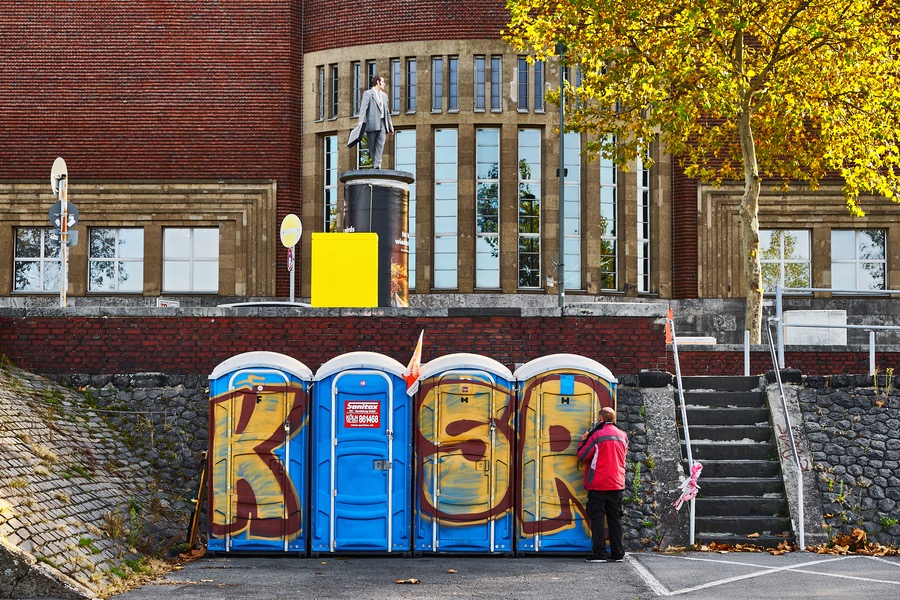
“Businessman” – from the Säulenheilige project by artist Christoph Pöggeler, Joseph Beuys Ufer Düsseldorf
Urban Lyricism & Photography: Between Elevation and Reality
Business as Usual
The pillar saint “Businessman” stands elevated, well-groomed, carrying a briefcase. A figure of progress, purpose, and constant motion. His gaze seems directed toward the distance, toward the place where decisions are made and deals are closed. The elevation lends him dignity, almost something sacred — as if business itself had become a matter of faith.
Below him, however, another kind of business is being conducted. Provisional, direct, close to the ground. The portable toilets, covered in graffiti, bear traces of use, appropriation, and everyday life. Beside them stands a man, absorbed in a task that carries no title here, yet is undeniably necessary — only without a pedestal.
The photograph brings both levels together without comment. The businessman remains distant, the activity below remains functional. And yet they are connected by more than what separates them: both represent ways of dealing with the city, processes that remain largely invisible as long as they function.
A quiet irony emerges. Not through mockery, but through juxtaposition. Business has many faces, and not all of them wear suits. Some stand above, others keep things running below. The urban lyricism of this image lies precisely in this quiet realization.
Above and Below

Pillar Saints “The Couple II” by Düsseldorf artist Christoph Pöggeler near the Tonhalle, Hofgarten ramp at Oberkassel Bridge
This photograph shows the sculpture “Pillar Saints – The Couple II” by Christoph Pöggeler, positioned on a tall pedestal and visibly elevated above the city. Two figures facing one another, fixed in a moment of quiet intimacy. The work is part of the urban space and at the same time deliberately distanced from it — art as observer, not participant. The photograph, however, dissolves this separation.
In the lower part of the image, a second reality appears: an overturned shopping cart filled with clothing and everyday belongings of a homeless person. No body is visible, yet the absence is palpable. The cart marks a temporary place, a mobile home that can be moved on or displaced at any moment. It stands in sharp contrast to the permanence of the sculpture above it.
This simultaneity is no coincidence, but an expression of urban reality. Cities produce images in which elevation — such as the pillar saints — and marginalization — such as homelessness — exist in close proximity without touching. The pillar saints and the shopping cart share the same place, but not the same visibility. The wall between them, overgrown with greenery and marked with graffiti, becomes both boundary and connection — a reservoir of urban traces.
Urban lyricism does not arise here through aestheticization, but through confrontation. The photograph does not arrange, does not comment, does not intervene. It records what is already there. In this restraint lies its essayistic strength: the image demands contemplation rather than quick interpretation.
The gaze oscillates between above and below, between art and survival, between stillness and movement. The pillar saints sculpture embodies permanence and closeness, the shopping cart precariousness and improvisation. Both are part of the same urban space, the same moment, the same image.
This photograph does not present living realities as opposites, but as coordinates within a complex structure. The poem of the city does not emerge from harmony, but from the simultaneity of the incompatible.
This article was posted on December 27, 2025