Photo Art: When Images Are More Than Snapshots. A Look at Fine Art Photography
Photography accompanies our daily lives like almost no other medium. With smartphones always at hand, we capture fleeting moments – often spontaneously, often casually. But photography can be far more than pure documentation. In photo art, the image becomes a means of expression, a conscious design, a visual language. Photo art tells stories, asks questions, and opens up new perspectives on the world. This blog article is dedicated to photo art in all its facets: from its definition and history to famous photographers and current developments. And it aims to encourage and embolden you to become artistically active in photography yourself!
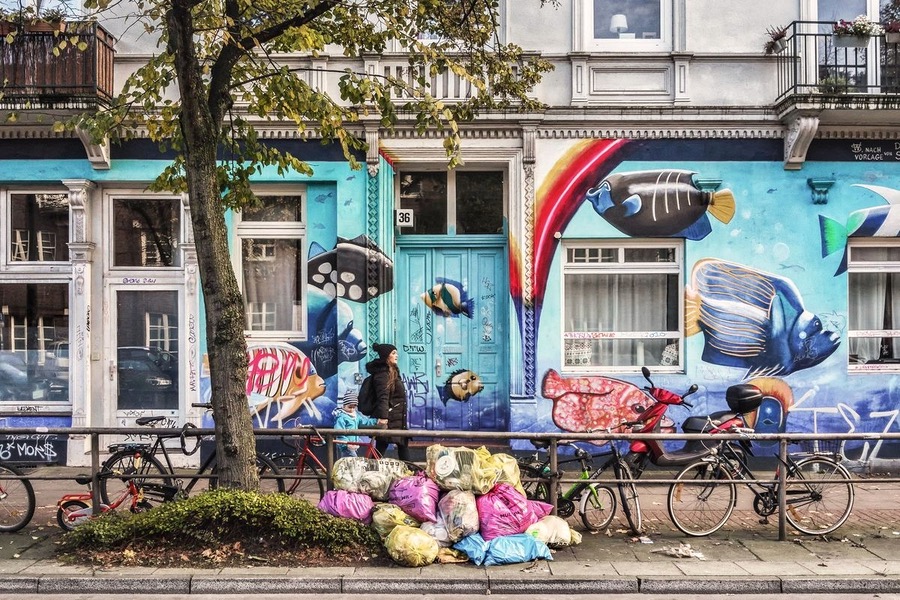
A seemingly banal street scene: a brightly painted house, passers-by – and trash lying in front of it. The photograph shows how humans strive to make their urban environment more beautiful while simultaneously failing at the small, everyday things. Framing, eye guidance, light, colors, and movement are consciously chosen to create a dynamic visual language. Even seemingly incidental details like the trash tell of the contradictions and ambitions of our cities, transforming the motif into photo art that tells stories and provokes thought. Title of the image: “Living in a World of Illusions and Trash”
CONTENTS
- 1 What exactly is photo art?
- 2 The “historical development” of photo art
- 3 Styles and Genres of Photo Art: An Incomplete Overview
- 4 Pioneering Photographers of Photo Art
- 5 Photo Art Today: Trends and Contemporary Positions
- 6 The Creative Process in Photo Art
- 7 Creating Your Own Photo Art: Tips for Getting Started in Fine Art Photography
What exactly is photo art?
Photo art refers to photography as an artistic medium. The focus is not on the mere depiction of reality, but on the photographer’s individual decision to perceive an image as an artistic expression. A fine art photographic work arises from a conscious attitude: motif, light, perspective, image composition, and post-processing are purposefully used to convey a specific statement, mood, or idea.
Photo art or fine art photography is not necessarily bound to total freedom. Artistic work can also emerge from a commission – the decisive factor, however, is that the photographer assumes creative autonomy and does not subordinate the image solely to functional requirements. Artistic merit arises where personal interpretation, a subjective gaze, and one’s own visual language are the deciding factors.
In contrast to purely documentary or purpose-bound photography, photo art does not prioritize utility. It does not have to explain, prove, or sell. Instead, it is allowed to remain open, raise questions, irritate, touch, or act exclusively on an aesthetic level. The photographer’s personal signature is not a byproduct, but its central characteristic.
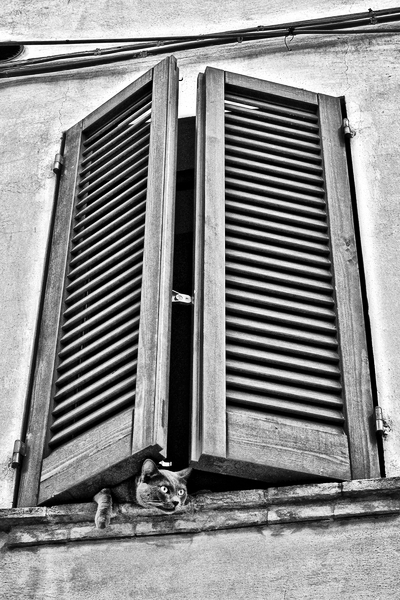
Fine art photography in black and white. Curious cat in Verona, Italy.
The “historical development” of photo art
The history of photo art begins in the 19th century, when photography was initially understood primarily as a technical process for the most exact reproduction of reality possible. Its value lay in precision and reproducibility, rather than individual expression. However, the desire to perceive photographs not just as documents but as independent works of art emerged early on.
Pictorialism: The Path to Artistic Photography
A central early approach was Pictorialism, which developed towards the end of the 19th century. This movement explicitly understood photography as an art form and drew heavily on the aesthetics of painting and graphic arts. Atmospheric lighting moods, conscious blurring, and interventions on the negative or print gave the images a subjective, handcrafted character. The goal was to break away from purely technical reproduction and secure photography an equal place among the arts.
Internationally, photographers like Alfred Stieglitz, Edward Steichen, and Gertrude Käsebier significantly shaped Pictorialism. In the German-speaking world, Georg Heinrich Emmerich, a teacher at the Bavarian State Institute for Photography, played an important role. He campaigned intensively for the artistic training of photographers and contributed decisively to establishing photography as a creative medium.
New Objectivity (Neue Sachlichkeit): The Autonomy of the Medium
In the early 20th century, New Objectivity formed as a conscious counter-movement to Pictorialism. Instead of painterly effects and subjective interventions, clarity, sharpness, precision, and a sober, often factual visual language moved into the foreground. Photography was no longer to imitate painting but to play to its own medial strengths.
Central representatives of this direction were August Sander, who made social structures visible with his systematic portraits; Albert Renger-Patzsch, who emphasized the formal beauty of industry, nature, and everyday objects in his works; and Karl Blossfeldt, whose strictly composed plant studies are still considered icons of objective photography today. The universal artist László Moholy-Nagy, a painter, photographer, and typographer, also influenced development through experimental perspectives and a radically modern conception of imagery.
Modernity and the Present: Freedom, Diversity, and Visibility
With the spread of 35mm cameras and later digital photography, creative possibilities expanded significantly. Technical hurdles decreased, while conceptual thinking, serial work, and personal visual languages came more into focus. Photography increasingly developed into a means of artistic reflection and individual engagement with the world and reality.
At the same time, photography has become a general cultural technique in the present day. Images are produced, shared, and consumed daily, especially via digital platforms like Instagram or other social networks. This permanent circulation of images shapes viewing habits, aesthetics, and the handling of photographic images as a whole.
Photo art, or fine art photography, moves within this expanded visual space without being absorbed by it. Today, it is a natural part of the contemporary art world, firmly anchored in museums, galleries, and collections, and simultaneously present in the digital space. Between documentary, staged, experimental, and digital forms of expression, it asserts its artistic claim through conscious design, conceptual depth, and a reflected attitude toward the medium itself.
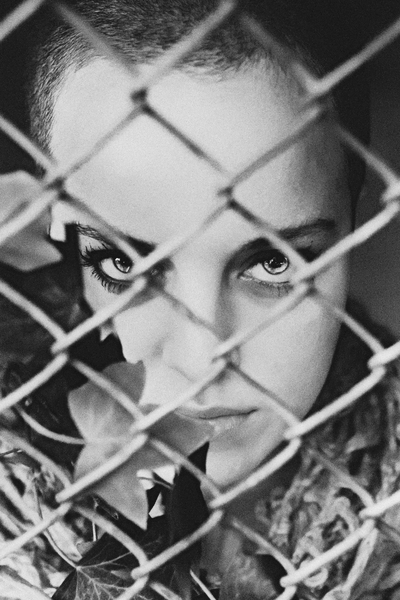
Hümeyra – The Runaway. Artistically staged photo portrait
Styles and Genres of Photo Art: An Incomplete Overview
Photo art is extremely diverse and eludes fixed categorizations. Nevertheless, different styles and genres have emerged over time that help to classify certain visual approaches. These divisions should not be understood strictly, as many works consciously move between genres or combine several approaches.
Portrait photography focuses on the person and goes far beyond classic stagings. It seeks personality, identity, and inner attitude, using proximity, distance, or conscious reduction to make the character of the subject visible. Landscape photography in photo art is also rarely purely documentary. Nature is interpreted, emotionally charged, or represented in an abstracted form, often as a mirror of inner states or as a commentary on social and ecological issues.
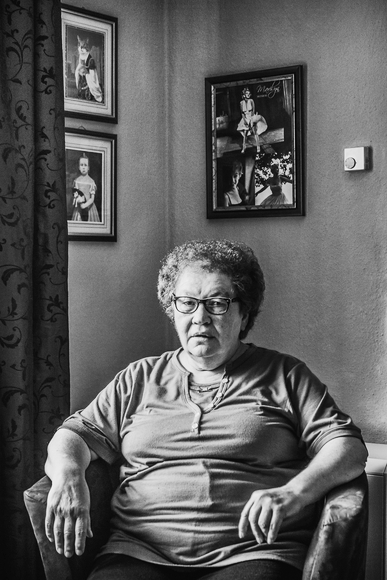
Pensioner in Gelsenkirchen, photographed for the book project “Gelsenkirchen Off the Football Pitch”
In conceptual photography, an idea or a question stands at the beginning of the image. Photography serves here as a visual means to make a thought visible. Individual images are often part of larger series or groups of works whose meaning only becomes clear in context. Street Photography, on the other hand, usually works spontaneously and observationally. It captures scenes of public space and condenses fleeting moments into images that make social structures, coincidences, or human gestures visible.
Abstract photography consciously detaches itself from clearly recognizable motifs. Shapes, colors, lines, and structures move into the foreground and open up an open space for associations. Finally, staged photography approaches the stage or film. Every detail – from the lighting to the setting to the posture of the people depicted – is planned and contributes to the overall impact of the image.
In addition to these established genres, terms like photo poetry or lyrical photography appear repeatedly. These are less clearly defined styles than descriptive terms for a certain visual attitude. Lyrical photography usually refers to a quiet, reduced visual language that works with suggestion, mood, and openness. Much like in lyric poetry, it is not about an unambiguous statement, but about resonance, atmosphere, and emotional nuances. Photo poetry describes photographs that suggest rather than tell, leaving room for interpretation and inviting the viewer to a personal reading.
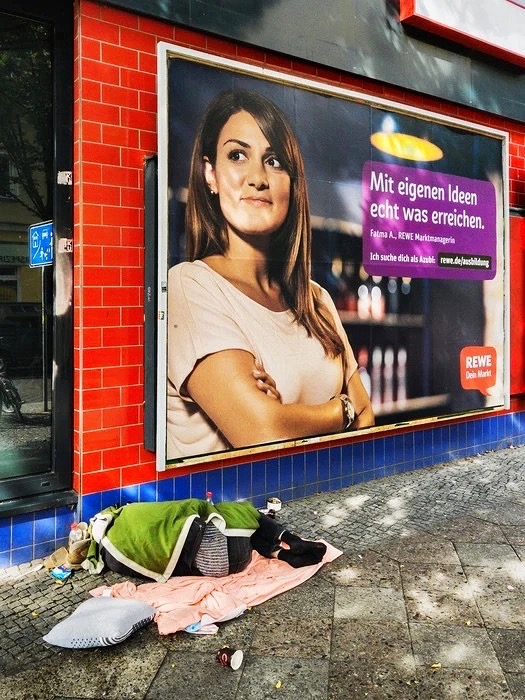
This photograph leaves the purely documentary because it does not just show a condition, but constructs a social statement through the conscious juxtaposition of an advertising message and a homeless person. Through framing, perspective, and timing, a clear authorial stance becomes visible, formulating irony and criticism of common success narratives. The image works with symbolism, shifts everyday contexts, and demands interpretation, whereby it goes beyond pure information and becomes readable as fine art photography.
Pioneering Photographers of Photo Art
This list does not claim to be exhaustive. Photo art knows countless significant photographers whose comprehensive representation would exceed the scope of this post. The selection is rather intended as an overview of central figures who have provided important aesthetic, technical, and conceptual impulses.
The Establishment of Photography as an Art Form
Alfred Stieglitz is considered one of the key figures of early photo art. Through his work and curatorial activities, he vehemently campaigned for establishing photography as an equivalent art form. His images move between Pictorialism and modern clarity, marking a decisive transition in photographic history.
Man Ray expanded photographic possibilities through experimental processes such as rayographs and solarized images. As part of the Surrealist movement, he finally detached photography from pure depiction and opened it to the subconscious and the abstract.
Documentation and Subjective Gaze
Henri Cartier-Bresson shaped an entire generation of photographers with his concept of the “decisive moment.” His street photographs combine formal precision with an intuitive feel for human situations, turning photography into a means of quiet observation.
Diane Arbus consciously directed her camera at social outsiders and marginalized figures. Her direct, often unsettling portraits challenged social norms and pushed the boundaries of what was considered representable.
August Sander created a photographic typology of German society with his long-term portrait project. His objective visual language combined documentary precision with deep social intent.
Nature, Form, and Formal Rigor
Ansel Adams became famous for his monumental landscape shots, in which he did not just document nature but aesthetically heightened it. His masterful black-and-white technique and the Zone System still influence photography today.
Karl Blossfeldt turned plants into sculptural objects. His highly enlarged, formally reduced shots reveal an abstract beauty that closely links photography and fine arts.
Albert Renger-Patzsch represented a radically objective conception of imagery. In his photographs of industry, architecture, and nature, he was concerned with clarity, structure, and the beauty of the visible in itself.
Concept, Staging, and Identity
Cindy Sherman used photography as a means of self-staging. In changing roles and identities, she questioned gender images, media clichés, and the construction of identity.
Jeff Wall staged photographic images with cinematic precision. His large-format works combine photography, painting, and cinema, raising questions about reality and staging.
Thomas Struth is known for his objective yet highly complex photographs of cities, museums, and families. His works examine social structures, collective memory, and the handling of images.
Bernd and Hilla Becher shaped an entire generation of photographers with their serial typologies of industrial structures. Their objective, systematic way of working formed the foundation of the so-called Düsseldorf School of Photography.
Contemporary Positions and New Standards
Andreas Gursky pushed the boundaries of photographic scale. His large-format, digitally edited images show global systems, consumer worlds, and architecture as abstract structures of overwhelming impact.
Wolfgang Tillmans stands for an open, experimental photography that oscillates between everyday observation, abstraction, and political stance. His works burst through classic presentation forms and think of photography as an ongoing process.
Hiroshi Sugimoto combines conceptual rigor with timeless aesthetics. His long exposures, seascapes, and architectural shots tematize time, perception, and transience.
Photo Art Today: Trends and Contemporary Positions
Photo art is in a state of constant change. Digital image processing, new printing techniques, interactive presentations, and now also the targeted use of artificial intelligence open up completely new creative possibilities within fine art photography. At the same time, the boundaries between photography, illustration, and media art are blurring, so that photo art today is often hybrid, performative, or multimedia.
Social and personal themes shape contemporary fine art photography more strongly than ever before. Questions of identity, gender, consumption, environment, or digitalization are at the center of many works. Photo art reflects not only the world but also the viewer’s perception in an increasingly mediatized society. In this context, social media and digital platforms influence not only the reach but also the aesthetics, visual language, and formats of fine art photography.
Contemporary photographers use this diversity in different ways. Nan Goldin, for example, documents intimate, personal life worlds with radical directness, creating narrative, emotional image series that make social realities tangible. Ryan McGinley works with staged, often performative scenes that tematize youthful freedom, connection to nature, and identity. Elina Brotherus combines landscape photography and self-portraiture into poetic, conceptually thought-out image series, while Thomas Ruff uses the possibilities of digital image processing to reflect on photography and imaging processes themselves.
These works illustrate that fine art photography today has an enormous range, both technically and conceptually. It moves between personal experience, social observation, and experimental formal language, always with the claim of going beyond mere depiction and developing its own recognizable visual language.
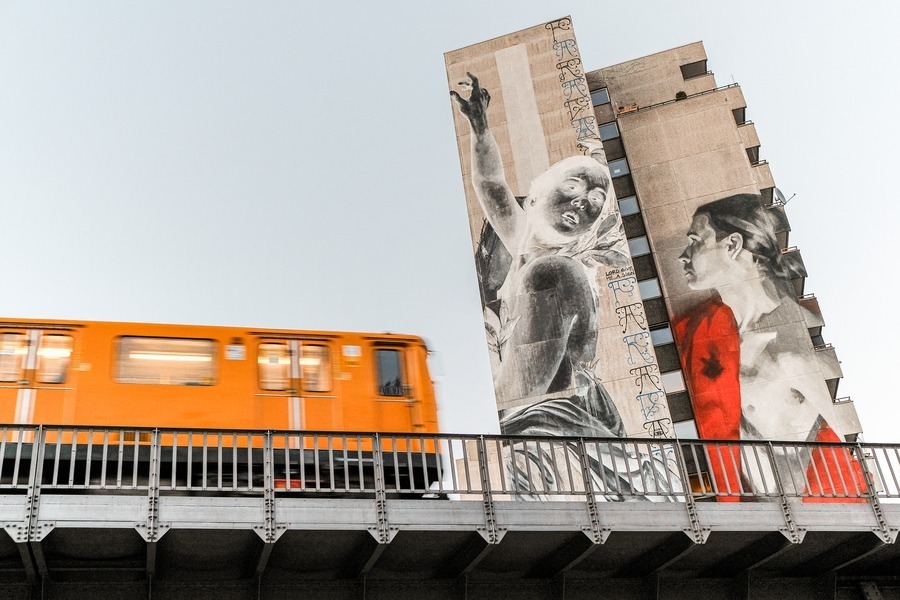
Through framing, timing, and perspective, a visual relationship arises between movement (train) and stillness (building with mural), which goes beyond pure documentation. The everyday scene is aesthetically condensed and receives a new layer of meaning. Thus, the photo points out that fine art photography does not need extraordinary motifs, but can consciously transform everyday moments.
The Creative Process in Photo Art
The path to a fine art photographic work usually begins not with the clicking of the camera, but with an inner attitude or question. This can be concretely formulated or initially develop intuitively, but it significantly determines how the photographer views motifs. From this basic decision arise the choice of motif, image structure, and the conscious handling of space, time, and perspective. The scene is not left to chance but actively designed, observed, or staged – even if the image appears spontaneous or documentary.
Light is not an incidental element but a central creative tool in photo art. It structures the visual space, directs the gaze, and creates atmosphere. Light can be consciously set, expectantly anticipated, or randomly used to support a spontaneous visual idea. Perspective and viewpoint are also conscious decisions: they define proximity and distance, power dynamics, and lines of sight. In photo art, timing therefore means less about reacting quickly than about patiently waiting for a constellation that corresponds to one’s own visual idea.
A key feature of fine art photographic work is the consistency of the visual language. Individual photographs rarely stand alone; they are part of an ongoing visual thought process. Recurring motifs, formal decisions, image structure and composition, or thematic focuses create coherence and make an artistic position recognizable. Over time, the photographer develops their own gaze, which continues and deepens in different projects.
Post-Processing as an Artistic Tool
In photo art, post-processing is not necessarily a “beautifying” subsequent intervention, but an integral part of the creative process. Even in the days of analog photography, negatives and prints were purposefully designed to achieve the desired effect. Photographers intervened actively by scratching negative surfaces, lengthening or shortening developer times, using push or pull processing, or working with light and shadow in the print. Manipulating paper surfaces, retouching, and selective exposures were also part of it.
Famous examples show how these techniques shaped visual language. Man Ray experimented with solarization and other darkroom interventions to create surreal effects. Edward Weston purposefully used contrast and selective sharpness to emphasize forms in landscapes and still lifes. Ansel Adams perfected the Zone System to precisely control tonal values and maximize the impact of light and shadow in his landscapes.
Colors, tonal values, contrasts, and framing are purposefully used to refine the content and aesthetic intention of the image. Even today, in digital photography, it is less about perfection and more about consistency and continuity of the visual language. Often, series or groups of works are created in which the meaning of individual images only becomes visible in interaction, forming a larger, often open-ended narrative.
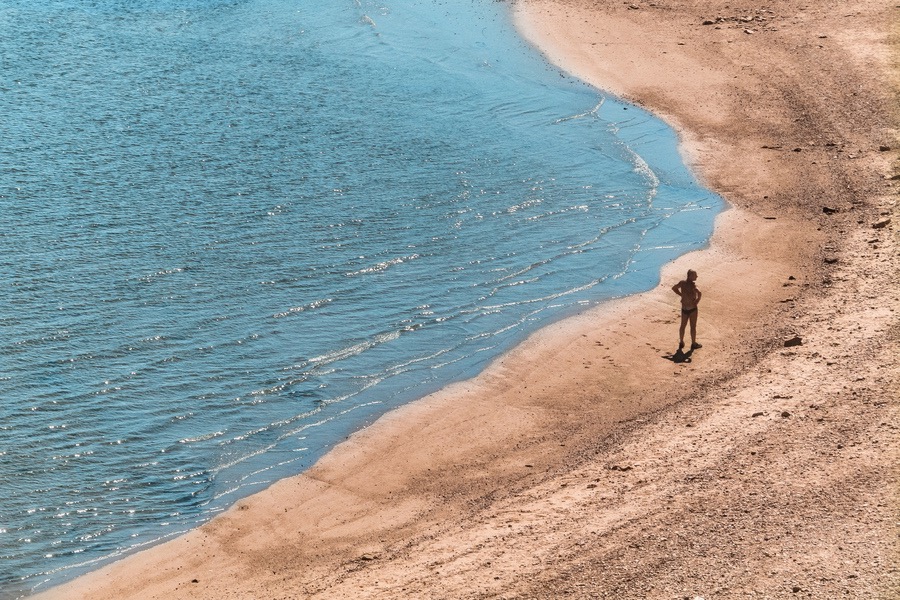
The individual human figure appears small and isolated in the vast landscape, addressing themes such as loneliness, contemplation, or the relationship between humans and nature. The reduced image structure, the clear lines of shore and water, and the calm coloring give the image a meditative, almost timeless effect. It does not just document a moment at the beach but invites interpretation and creates an emotional and symbolic level beyond the purely representational.
Manipulation as a Conceptual Tool: Andreas Gursky and Rhein II
A particularly well-known example of targeted image design in contemporary photo art is Andreas Gursky’s Rhein II from 1999. At first glance, the image looks like a sober, documentary landscape shot of the Rhine. Upon closer inspection, however, it becomes clear that Gursky intervened actively: using digital editing, he removed elements such as boats, people, and trees to simplify the composition and create a clear horizontal structure.
This manipulation was not a technical game but a conscious creative tool that supports the aesthetic effect, the reduction to form and color, and the serial order of his landscape photographs. Rhein II illustrates that post-processing in photo art serves not only to correct technical shortcomings but can be an integral part of the creative process. Through digital intervention, an image is created that is both conceptually and visually stringent and bears Gursky’s characteristic signature.
The controversial debates surrounding photo art can be observed exemplarily in a Reddit post on Andreas Gursky’s Rhein II, in which aesthetic judgments, incomprehension, and questions of art theory condense. Discussion on reddit.
Creating Your Own Photo Art: Tips for Getting Started in Fine Art Photography
Visual Language is More Important Than Technique
Anyone who wants to create their own photo art should be guided less by perfect technique and more by a clear, personal visual language. Photography is a means of expression, much like language in writing. You don’t have to have studied German literature to write a poem; language is available to everyone. Similarly, you don’t have to have attended an art academy to practice fine art photography – the camera and the design possibilities are tools open to all. Photo art arises primarily through conscious decisions, repetition, reflection, and experimental approaches. Inspiration can come from art, literature, film, or everyday life. Observation, mindfulness of details, and the conscious perception of moods are often just as valuable as technical skill.
Projects Instead of Individual Images: Work Through Themes Artistically!
Instead of focusing on single, isolated images, it is worth thinking in terms of projects or series. This creates a consistent visual language that has recognition value and unfolds a greater narrative or emotional impact. Experiments with light, perspective, image composition, or unusual motifs help in finding your own style of fine art photography and continuously developing it. Every series becomes an expression of your own perspective and a building block of your personal artistic signature.
Criticism, Exchange, and Patience
Criticism, exchange, and feedback, whether in photo clubs, online communities, or among friends, are valuable tools for sharpening your own gaze and discovering new perspectives. Above all, however, photo art takes time, patience, and the willingness to allow for mistakes. Every shot, even if it is not perfect, contributes to the personal development process.
The Conscious Shaping of the World Through Artistic Photography
Most importantly, photographs should be consciously designed. Photo art means not just documenting the world, but actively interpreting it, questioning it, and making it visible in one’s own language. Anyone who adopts this attitude can begin to continuously improve and develop a personal artistic signature, regardless of education, equipment, or status. Photo art is an expression of one’s own perception – like a poem that transforms one’s thoughts and feelings into language, images become a mirror of the individual’s gaze upon the world.
This article was posted on December 30, 2025