How Lightness Recalibrates Our View of the World
In architectural photography, the monumental often dominates. The Dreischeibenhaus in Düsseldorf, an icon of German post-war modernism, typically stands as a symbol of permanence, economic power, and vertical dominance. Yet, in this photograph, the coordinates of perception shift. The title “How Lightness Recalibrates Our View of the World” sets the stage: it describes a process of visual emancipation.
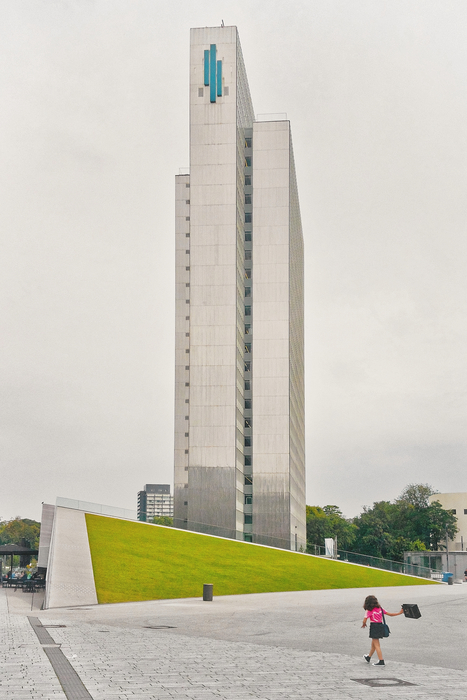
Dreischeibenhaus in Düsseldorf.
The Architecture of Heaviness
At first glance, the building commands the scene. Its three offset slabs rise like stone sentinels into an almost white, endless sky. The geometric rigidity and sheer mass of the skyscraper embody a world functioning according to fixed rules, efficiency, and stability. It is a world of the “grand,” where humans often serve merely as a sense of scale to illustrate the gigantomania of the construction.
The Pendulum of Attention
However, the photograph breaks with this expectation. While the Dreischeibenhaus occupies the left and center of the frame vertically, the true event unfolds in the bottom right corner. There, a young girl moves with carefree dynamism.
Her gesture—the wide swing of her shopping bag—is an act of pure joy. In this moment, the bag is not perceived as a burden, but as a toy, an extension of her own energy. This movement forms the emotional counterweight to the millions of tons of steel and concrete in the background.
Recalibrating the World
This is where the photographer’s intention is realized: The massive building does not capture the viewer’s gaze; instead, it releases it, allowing the eye to linger on the lightness of the human moment.
- Proportion vs. Presence: Although the girl occupies only a fraction of the image area, she possesses the greater narrative presence.
- Color and Dynamics: The lush green of the sloped lawn acts as a visual bridge. It guides the eye down from the static architecture to the dynamic figure of the child.
The photograph teaches us that “size” is not a matter of square meters or floor counts. By turning away from the gigantic and focusing on a small, fleeting moment of lightheartedness, the scale of the world changes. The Dreischeibenhaus becomes a mere backdrop for a moment that proves: True relevance lies not in the monumental, but in the freedom of the individual to move playfully through space. Lightness recalibrates the world—not in meters, but in moments of happiness.
The “Three Disc House” in Dusseldorf
The Dreischeibenhaus is one of the most striking high-rise buildings in Germany and an outstanding example of post-war modernism. It is located in the heart of Düsseldorf, not far from the Hofgarten and Königsallee, and is regarded as a symbol of the economic recovery of the Federal Republic of Germany after the Second World War.
Architects and development of the Dreischeibenhaus
The Dreischeibenhaus was built between 1957 and 1960 and designed by the architects Helmut Hentrich and Hubert Petschnigg (Architekturbüro Hentrich, Petschnigg & Partner). With the Dreischeibenhaus, the architects created a visionary high-rise building that attracted international attention thanks to its clear design language and elegant design.
Architecture and design
The building owes its name to its tripartite shape: It consists of three vertical, disc-like structures that stand parallel to each other. The middle disc houses the main use, while the two outer, narrower discs form the façades. This construction gives the building its slender, almost floating effect.
The façade of the Dreischeibenhaus is characterised by a clear glass and aluminium construction, which was innovative for the time and underlines the elegance of the International Style. The front sides are clad with bevelled stainless steel surfaces, which gives the building additional radiance. It is worth noting that this is a steel frame construction, which was unique in Europe at the time.
Facts and figures
- Height: 95 metres
- Floors: 25
- Façade: The glass and aluminium façade is typical of the modern architecture of the 1950s and underlines the elegant, functional character of the building.
- Architectural style: International modernism / post-war modernism
Use and importance of the Dreischeibenhaus
The Dreischeibenhaus looks back on an eventful history. After its completion in 1960, it initially served as the headquarters of Phoenix-Rheinrohr AG Vereinigte Hütten- und Röhrenwerke, which was taken over by Thyssen AG in 1964. In the decades that followed, the building was closely associated with the Thyssen industrial group and was long regarded as one of the most modern office buildings in Germany. After the merger of Thyssen and Krupp in 1999, the Dreischeibenhaus was also part of the headquarters of the new ThyssenKrupp AG.
In 2010, ThyssenKrupp moved out of the building and it was subsequently sold. Between 2013 and 2015, the tower block was extensively refurbished by architects HPP Hentrich-Petschnigg und Partner, who had designed the original building. They succeeded in preserving the listed façade while at the same time bringing the technical standards up to a contemporary level.
Today, the Dreischeibenhaus is once again used as a state-of-the-art office building and is home to numerous well-known companies, including A.T. Kearney, Allen & Overy, Alltours, Black Horse Investment, Cadman, Collection Business Center, Gleiss Lutz, Jones Lang LaSalle, Latham & Watkins, Roland Berger and the international commercial law firm Clyde & Co. The ground floor is also home to the upscale restaurant ‘Phoenix’, which is housed in the former telephone exchange and has been part of the gastronomic offering in Düsseldorf city centre since December 2015.
The Dreischeibenhaus is therefore not only an architectural landmark of the post-war period, but also a vibrant part of the city’s economic and cultural centre.
Art print of the Dreischeibenhaus
You can purchase an art print of the image above of the Dreischeibenhaus in Düsseldorf here: Art print Dreischeibenhaus
This article was posted on November 10, 2025